Perimenopause Anxiety: Why You Feel Anxious for No Reason
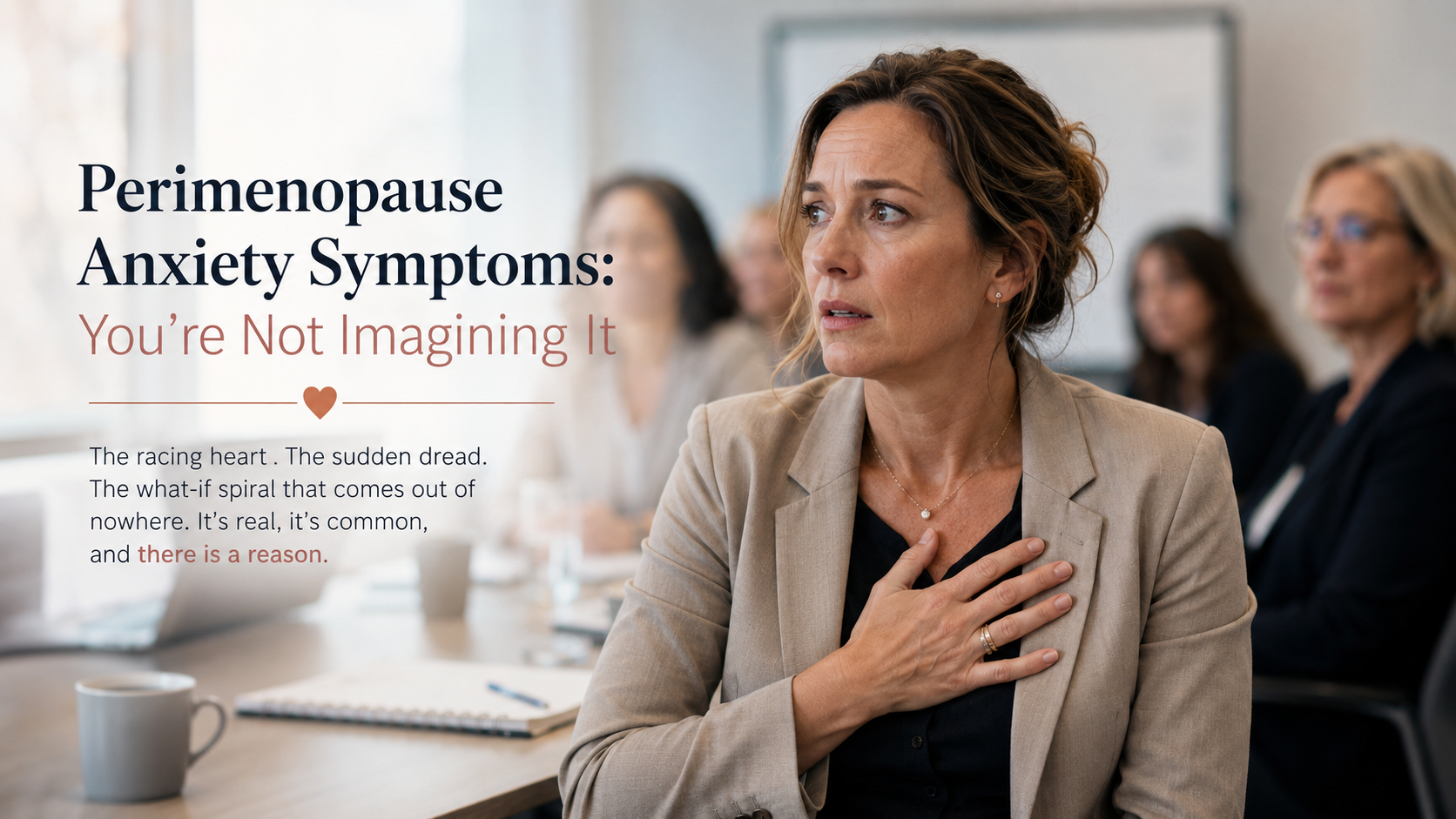
You're sitting in a meeting at work, nothing particularly stressful is happening, and suddenly your heart starts racing. Your mind jumps to worst-case scenarios you can't quite name. You feel a creeping sense of dread that you can't shake — and you have absolutely no idea why. If that sounds familiar, you're not imagining it, and you're definitely not losing your mind. Perimenopause anxiety symptoms are one of the most common — and most misunderstood — experiences for women in their 40s and beyond, yet so many women spend months (sometimes years) thinking something is seriously wrong with them before they connect the dots.
In this article, we're going to break down exactly why perimenopause causes anxiety, what's happening in your brain and body, and what you can actually do about it. Because understanding what's going on is genuinely the first step to feeling like yourself again.
Your Hormones Are Running the Show (And They're Getting Unpredictable)
Here's the thing about perimenopause that most people don't talk about enough: it's not just about your periods going haywire. Perimenopause is a hormonal transition that can last anywhere from a few years to over a decade, and during that time, your estrogen and progesterone levels don't just gradually decline — they fluctuate wildly.
Think of it like a rollercoaster rather than a gentle slope downhill. One week your estrogen is surging. The next, it drops. Then it surges again. These unpredictable swings are largely responsible for the emotional turbulence so many women experience during this stage.
The estrogen-anxiety connection
Estrogen has a direct relationship with serotonin and GABA — two of your brain's key "calm down" chemicals. When estrogen levels drop, serotonin production can decrease, and GABA activity (which is essentially your brain's natural anxiety buffer) can become less effective. The result? Your nervous system becomes more reactive. Things that never used to bother you suddenly feel overwhelming.
That's why perimenopause anxiety symptoms can feel so different from the anxiety you might have experienced earlier in life. It often comes out of nowhere. No obvious trigger. No big life stress. Just a low-level hum of unease that follows you around — or sudden spikes of panic that feel completely disproportionate to the situation.
Progesterone: the calming hormone you're losing
Progesterone is sometimes called the "calming hormone" for good reason. It acts on the same receptors in the brain as benzodiazepines (yes, the same type as anti-anxiety medications). As progesterone declines in perimenopause — often before estrogen does — many women lose a significant chunk of their natural anxiety-buffering system without realising it.
So if you've been wondering why you suddenly feel more anxious, more irritable, or more on edge than you've ever been in your life, this is a huge part of the answer.
Perimenopause Anxiety Symptoms Don't Always Look Like "Classic" Anxiety
When most people picture anxiety, they think of someone visibly panicking or worrying obsessively. But perimenopause anxiety often shows up in ways that are easier to dismiss or misattribute.
Here's what it can actually look like:
- Heart palpitations — a racing or fluttering heart, often at rest or during the night, that feels alarming but has no cardiac cause
- A sense of impending doom with no identifiable source
- Feeling overwhelmed by things that used to feel manageable
- Difficulty sleeping because your mind won't switch off
- Irritability and a short fuse that feels out of character
- Muscle tension, particularly in the neck, jaw, and shoulders
- A feeling of being disconnected from yourself (sometimes called depersonalisation)
- Sudden surges of anxiety that come and go quickly, almost like mini panic attacks
The tricky part? Many of these symptoms overlap with other conditions — thyroid issues, vitamin deficiencies, cardiovascular problems — so it's worth getting a proper check-up if these are new for you. But if your GP has ruled out other causes and you're in your 40s or early 50s, perimenopause is very much worth putting on the table as a conversation.
Why Sleep Deprivation Makes Everything So Much Worse
Let's be honest: perimenopause anxiety and sleep problems are basically best friends, and not in a good way. Night sweats wake you up. Your mind races. You lie there at 3am catastrophising about things you'd normally brush off.
And here's the cruel irony: sleep deprivation itself causes anxiety. So you end up in a loop where the hormonal changes disrupt your sleep, and the sleep deprivation amplifies the anxiety, which makes it even harder to sleep.
The HPA axis — your body's stress response system — becomes dysregulated when you're chronically sleep-deprived. Cortisol (your stress hormone) ends up elevated at the wrong times, which makes your nervous system jumpy and on high alert. Many women going through perimenopause are essentially living in a state of low-grade stress response without ever knowing why.
If you recognise this cycle, you're not alone. It's one of the most consistent patterns we hear about from women at orozna.com — the exhaustion, the anxiety, the feeling that everything is just slightly too much. And it's one of the reasons that addressing sleep in perimenopause isn't optional; it's foundational.
The Brain Fog, Mood Swings, and Anxiety Triangle
Perimenopause doesn't just affect how anxious you feel — it affects how you think, remember, and process emotions. And when these three things collide, it can feel genuinely frightening.
When anxiety meets brain fog
Brain fog — that frustrating inability to find words, remember why you walked into a room, or concentrate on a task — is extremely common in perimenopause. And when it happens alongside anxiety, it creates a really destabilising combination. You forget something, feel anxious about what that means, then catastrophise about your cognitive health.
Here's what's reassuring: most perimenopausal brain fog is hormonal, not a sign of early cognitive decline. Estrogen plays a role in memory and cognitive function, so when it fluctuates, so does your mental sharpness. It tends to stabilise as you move through the transition.
Mood swings that feel bigger than PMS ever did
If you've been living with PMS-related mood changes for years, perimenopause can feel like someone turned up the volume to eleven. The emotional dysregulation that comes with fluctuating hormones can feel completely outsized compared to what you're used to.
One woman we've heard from through orozna.com described it as "feeling like I was made of glass — everything shattered me in a way that just wasn't normal for me." That's not weakness or emotional fragility. That's your brain chemistry responding to hormonal shifts it's never experienced before in quite this way.
If you're looking for structured support to understand what's happening in your body and build practical strategies around it, orozna.com's resources for women in perimenopause and menopause are designed specifically to meet you where you are — with information that's actually useful, not overwhelming.
What Actually Helps: Practical Approaches for Perimenopause Anxiety
Now for the part you actually came here for. There's no single magic fix — but there are things that genuinely move the needle, and it helps to know what they are so you can start somewhere.
Regulating your nervous system daily
Your nervous system needs regular "reset" inputs, not just occasional self-care. Think of things that consistently signal safety to your brain:
- Slow, extended exhales (breathing out longer than you breathe in activates the parasympathetic nervous system)
- Cold water on your face or wrists during an anxiety spike — this triggers the dive reflex and slows heart rate
- Gentle movement like walking, yoga, or swimming, which burns off stress hormones without spiking cortisol further
- Consistent sleep and wake times, which anchor your circadian rhythm and help stabilise cortisol patterns
These aren't fluffy suggestions. They have real physiological effects on the anxiety response, and consistency is what makes them work.
Nutrition and the anxiety connection
Blood sugar instability — something that becomes more common as estrogen declines — can trigger anxiety responses that feel hormonal but are partly metabolic. Eating regular meals with protein, fat, and fibre helps keep blood sugar stable, which takes a surprising amount of pressure off your nervous system.
Magnesium is worth knowing about here too. It supports GABA function (that calming brain chemical we mentioned earlier), and many women are deficient without knowing it. Food sources include dark leafy greens, pumpkin seeds, dark chocolate, and legumes. Worth talking to your doctor or nutritionist about whether supplementation makes sense for you.
Talking to your GP about your options
This one's important. Perimenopause anxiety is a medical issue, not just a lifestyle problem to optimise your way out of. Hormone Replacement Therapy (HRT) can be genuinely life-changing for some women whose anxiety is primarily hormone-driven. Antidepressants and anti-anxiety medications are also valid options when anxiety is significantly impacting quality of life.
Don't white-knuckle it when there's support available. You wouldn't avoid treatment for a thyroid condition — this isn't different.
Reducing stimulants that amplify the anxiety response
Caffeine and alcohol both interfere with anxiety regulation in perimenopause more than most women expect. Caffeine raises cortisol and can directly trigger palpitations and anxiety spikes, especially in the second half of your cycle. Alcohol disrupts sleep architecture and, despite its short-term calming effect, increases anxiety the day after. Even small reductions can make a noticeable difference.
How to Tell If What You're Experiencing Is Perimenopause Anxiety (And Not Something Else)
This is a question we hear a lot, and it's a fair one. Perimenopause anxiety symptoms can genuinely overlap with generalised anxiety disorder, thyroid dysfunction, anaemia, and other conditions. So how do you know?
A few patterns that tend to point toward perimenopause as the primary driver:
The anxiety is new, or significantly worse than it's ever been, and started in your 40s. It tends to fluctuate in a way that feels cyclical or unpredictable rather than constant. It comes alongside other perimenopausal signs — irregular periods, sleep disruption, hot flushes, changes in your cycle. And it doesn't seem to have a clear psychological trigger.
That said, getting a blood panel done is always worthwhile. Thyroid function, iron levels, B12, and vitamin D can all influence anxiety, and they're easy to check. Bring up perimenopause explicitly with your doctor — many women have to advocate for themselves in this area, because menopause is still under-discussed and under-diagnosed in primary care settings.
Understanding what's driving your anxiety matters, because it shapes what will actually help. Working with your body's hormonal reality — rather than against it or around it — is where lasting relief tends to come from.
You've spent years figuring out your body's rhythms, and perimenopause doesn't change that — it just adds a new chapter that takes some learning. The anxiety you're feeling isn't permanent, it isn't a character flaw, and it isn't you falling apart. It's a physiological response to a very real transition, and with the right support and information, it becomes manageable. If you want a well-structured starting point for understanding your perimenopause journey and what you can do about it, explore orozna.com's digital resources built for women navigating perimenopause and menopause — they're made for exactly where you are right now.