How to Track Your Cycle in Early Perimenopause (When It Makes No Sense)
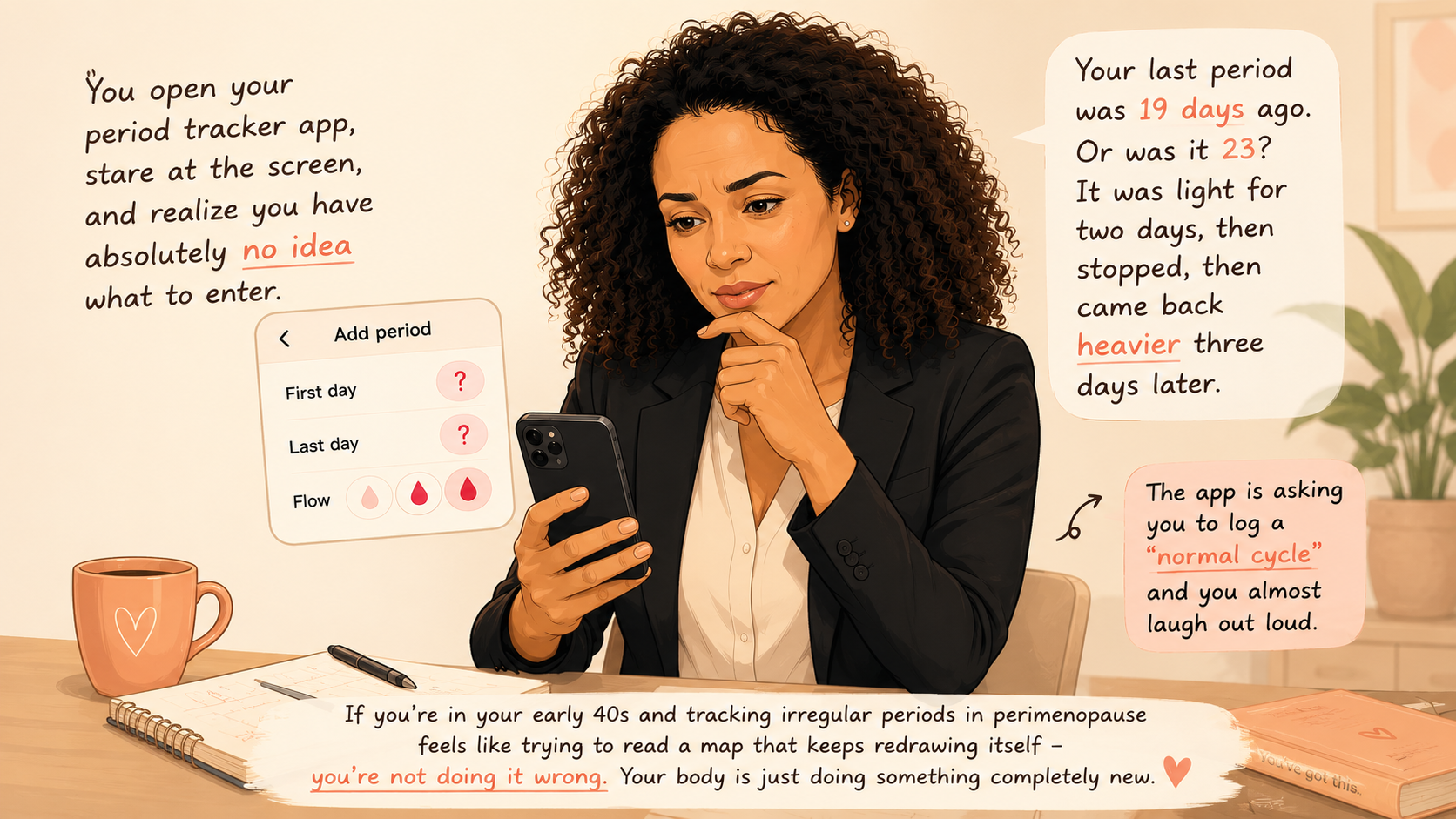
You open your period tracker app, stare at the screen, and realize you have absolutely no idea what to enter. Your last period was 19 days ago. Or was it 23? It was light for two days, then stopped, then came back heavier three days later. The app is asking you to log a "normal cycle" and you almost laugh out loud. If you're in your early 40s and tracking irregular periods in perimenopause feels like trying to read a map that keeps redrawing itself — you're not doing it wrong. Your body is just doing something completely new.
In this article, you'll learn why cycle tracking still matters even when your periods are unpredictable, what to actually track (hint: it's not just dates), and how to use that information to feel more in control of what's happening to your body. Because understanding your pattern — even when the pattern is that there isn't one — is genuinely useful.
Why Your Cycle Stops Making Sense in Perimenopause
Perimenopause doesn't arrive with a neat announcement. It creeps in, usually somewhere between your late 30s and mid-40s, and one of the first things it messes with is your cycle. You might go from a reliable 28-day cycle to something that shows up every 21 days, then skips entirely, then comes back with a vengeance for three weeks straight.
This happens because your ovaries are producing estrogen less predictably. Some months you ovulate normally. Other months you don't ovulate at all — which means no progesterone to balance things out. That hormonal push-and-pull is what creates the chaos.
The result? Cycles that are shorter, longer, heavier, lighter, or just plain confusing. And standard period tracker apps — the ones designed for women trying to conceive or avoid pregnancy — are built around a consistent cycle. They're not built for you right now.
That doesn't mean you should stop tracking. It means you need to track differently.
What "Tracking Irregular Periods in Perimenopause" Actually Means
Most women come to cycle tracking in perimenopause with the same goal they had in their 20s: predict when their period is coming. That goal makes total sense — and it's still worth pursuing — but it's no longer the only reason to track, or even the most important one.
Track the symptoms, not just the dates
In perimenopause, your symptoms are data. Hot flashes, night sweats, brain fog, irritability, sleep disruption, joint aches — these are all connected to where you are in your hormonal cycle, even if the cycle itself is irregular. When you start logging these alongside your period dates, patterns emerge that would otherwise be invisible.
For example: you might notice that your anxiety spikes and your sleep falls apart in the week before bleeding starts. That's a sign of low progesterone in your luteal phase — something many women in perimenopause experience. Without tracking, it just feels random and overwhelming. With tracking, it becomes information you can actually use.
Track flow and texture, not just duration
Heavy flooding one month and barely a spot the next? That's worth recording. Changes in flow — particularly very heavy periods that soak through a pad or tampon in an hour or less — can indicate fibroids, polyps, or other issues that your doctor needs to know about. Logging flow gives you something concrete to bring to appointments instead of "my periods have been weird lately."
Track your cycle length windows, not a single number
Instead of expecting a 28-day cycle, start thinking in ranges. If your last six cycles have been anywhere from 21 to 45 days, that's your current normal. Write it down. That range is your new baseline, and any cycle that falls dramatically outside of it is worth noting.
The Tools That Actually Work (and the Ones That Don't)
Let's be honest: most period tracking apps are designed for a different life stage. They're optimized for regular cycles, fertility windows, and ovulation prediction. When you input wildly varying cycle lengths, they either glitch out or give you nonsense predictions. That's not helpful when you're already feeling like your body is a mystery.
What works better for perimenopause tracking
- A simple notebook or journal — old-fashioned, yes, but incredibly effective. You control what you log. There's no algorithm trying to normalize your data.
- A symptom-forward app — look for apps that let you log mood, energy, sleep, and physical symptoms alongside bleeding. Some menopause-specific apps are starting to do this well.
- A digital template or tracker worksheet — a structured format that's actually designed for irregular cycles and perimenopausal symptoms can make logging feel less overwhelming and more useful.
- Your phone's notes app — sometimes the most frictionless tool is the best one. A quick daily note takes 30 seconds and adds up to meaningful data over months.
If you're looking for a structured approach that doesn't require you to build a system from scratch, orozna.com's digital tools for women in perimenopause and menopause are designed specifically for this stage of life — not repurposed from a fertility tracker.
How to Actually Start When Everything Feels Chaotic
Here's something we hear often from women who come to tracking late in their perimenopause journey: "I wish I'd started sooner." The women who have the most useful conversations with their doctors, and the ones who feel most prepared for what comes next, are the ones who have at least six to twelve months of logged data behind them.
But starting feels hard when nothing is predictable. So let's make it simple.
The three-minute daily check-in
You don't need to fill out a detailed form every morning. You just need to answer three questions:
- Did I bleed today? (Yes / No / Spotting — and if yes, how heavy?)
- How did I sleep last night? (Good / Broken / Terrible)
- What's my mood and energy like today? (One word is fine.)
That's it. Three questions, thirty seconds to a minute, done. When you look back at three months of these daily check-ins, you'll start to see your own version of a pattern — even if the cycle length itself never becomes predictable.
Don't wait for a "new cycle" to start
One of the most common reasons women delay starting a tracker is that they're waiting for a period to arrive so they can "start fresh." Don't wait. Start today, wherever you are in your cycle — or wherever you think you might be. Imperfect data logged consistently is infinitely more useful than perfect data you never actually collected.
When Tracking Tells You Something You Need to Act On
Cycle tracking in perimenopause isn't just about self-knowledge. Sometimes it surfaces things that need medical attention.
There are certain patterns worth bringing to your doctor promptly — not to alarm you, but because early information leads to better outcomes. These include:
- Bleeding that lasts longer than seven days consistently
- Soaking through a pad or tampon every hour for two or more hours in a row
- Spotting between periods that happens repeatedly
- Any bleeding that occurs more than twelve months after your last period (that's postmenopausal bleeding, which always warrants investigation)
Having a log of when these things happened, how heavy they were, and what other symptoms accompanied them makes your doctor's job easier — and makes it much less likely that your concerns get dismissed or minimized. Your logged data is your advocate in that appointment room.
It's also worth noting that many women in perimenopause are simultaneously dealing with fibroids, which are extremely common in this decade of life and can cause heavy, unpredictable bleeding that gets mistaken for "just perimenopause." Tracking gives you the specificity to tell the difference.
Making Peace With the Unpredictability (While Still Staying Informed)
There's a certain kind of mental exhaustion that comes from trying to predict something that genuinely cannot be predicted. If you've been fighting your irregular cycle — checking your tracker app daily hoping it'll suddenly give you accurate predictions — it might be time to shift your relationship with tracking entirely.
The goal isn't to control your cycle. It's to understand it on its own terms.
Some months, the data will show a clear pattern. Other months, it'll look like noise. Both are normal. What you're building, over time, is a picture of your own perimenopause experience — one that's useful for healthcare conversations, for noticing when something feels genuinely different, and for making sense of why you felt a certain way on a particular day.
The bigger picture tracking helps you see
Women who track consistently through perimenopause often report something unexpected: it reduces their anxiety. Not because the symptoms stop, but because they stop feeling random. When you can look back at your notes and see that the week before your period you always feel foggy and low, that information is weirdly comforting. It's not that something is wrong with you — it's just that week.
That kind of self-knowledge is hard to put a value on. And it compounds. Six months of data is useful. A year of data is powerful. Two years of data, by the time you're approaching menopause, gives you and your healthcare provider a genuinely detailed picture of your hormonal journey.
Understanding your own body during this transition is something you build gradually, one logged day at a time — and if you want a structured starting point that's built for irregular cycles and perimenopausal symptoms rather than against them, orozna.com's digital resources for women in perimenopause can give you a framework that actually fits where you are right now.
Your cycle may not make sense yet, and that's okay. What matters is that you start paying attention — messily, imperfectly, with a notebook and three questions if that's all you have. The pattern will emerge. And when it does, you'll be glad you were watching.