The Truth About HRT in Perimenopause (Separating Fear from Facts)
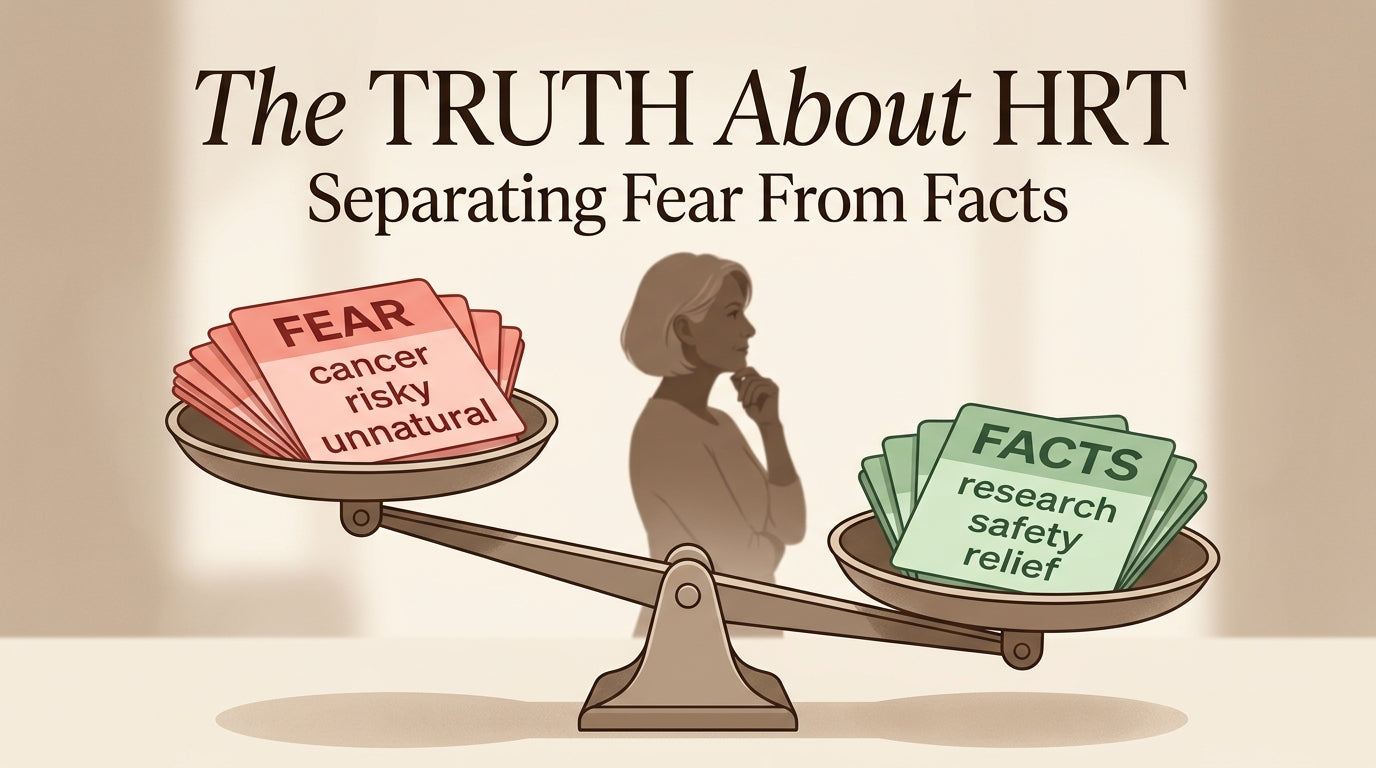
You're lying awake at 3am, drenched in sweat, heart racing — and your mind starts going down a rabbit hole you've probably visited before: Should I try HRT? You've heard horror stories. You've also heard women swear by it. You've Googled until your eyes blur, only to end up more confused than when you started. If you're in perimenopause and trying to make sense of the HRT perimenopause benefits risks conversation, you are absolutely not alone. This is one of the most emotionally charged, frequently misunderstood topics in women's health — and it deserves a straight, honest conversation, not a list of scary statistics designed to send you running.
In this article, we're going to break down what HRT actually is, where the fear around it came from, what the current evidence really says, and how to figure out whether it might be right for you. By the end, you'll have the context you need to have a genuinely informed conversation with your doctor — instead of nodding along while secretly feeling lost.
Where All the Fear Around HRT Actually Came From
Let's go back to 2002. A large study called the Women's Health Initiative (WHI) published results suggesting that hormone replacement therapy increased the risk of breast cancer, heart disease, and stroke. The headlines were terrifying. Doctors stopped prescribing HRT almost overnight. Women who had been managing their menopause symptoms effectively were suddenly told to stop.
Here's the thing though — and this is genuinely important — that study had some serious design flaws that the medical community has spent the last two decades unpicking.
The women in the WHI study were, on average, 63 years old. Many had existing health conditions. They were given a specific type of synthetic hormone that isn't even the most commonly used form today. And yet the findings were applied broadly to all women considering HRT at any age — including women in their 40s and early 50s who are navigating perimenopause.
That's like saying a medication that caused problems in a 75-year-old cardiac patient is dangerous for a healthy 45-year-old. The context matters enormously.
What We Know Now
Since 2002, dozens of follow-up studies, re-analyses, and updated guidelines have significantly changed the picture. Major medical bodies — including the British Menopause Society and the Menopause Society (formerly NAMS in the US) — now take a much more nuanced position. For most healthy women under 60 who are within 10 years of their last period, the benefits of HRT generally outweigh the risks.
That's not a fringe opinion. That's the current medical consensus. It just hasn't filtered through to public awareness the way the 2002 scare stories did.
What HRT Actually Does in Your Body During Perimenopause
Perimenopause isn't a single moment — it's a transition that can last anywhere from a few years to over a decade. During this time, your ovaries start producing less oestrogen and progesterone, and the fluctuations can be wild. One month your hormones are relatively stable; the next you're crying at a supermarket receipt and can't sleep for a week.
HRT works by supplementing the hormones your body is producing less of, helping to smooth out those fluctuations. It's not about reversing ageing or pumping yourself full of artificial chemicals — it's about supporting your body through a major biological shift.
The most common symptoms it helps with include:
- Hot flushes and night sweats
- Sleep disturbances
- Mood swings, anxiety, and low mood
- Brain fog and difficulty concentrating
- Vaginal dryness and discomfort during sex
- Joint pain and muscle aches
- Low libido
For many women, these symptoms are genuinely debilitating. Not "a bit annoying" — debilitating. Women losing jobs because they can't concentrate. Relationships breaking down because they feel like strangers in their own skin. HRT isn't vanity. For a lot of women, it's a quality-of-life issue.
Beyond Symptom Relief: The Longer-Term Health Picture
This part often surprises people. HRT isn't just about managing hot flushes in the short term. There's a growing body of evidence suggesting it may offer longer-term protective benefits when started during perimenopause or early menopause.
Oestrogen plays a role in bone density, cardiovascular health, and brain function. When levels drop significantly, so does that protection. Starting HRT during the "window of opportunity" — before menopause is fully established — may help maintain bone health and reduce the risk of osteoporosis, and some research points toward potential cardiovascular benefits too.
Again, this doesn't mean HRT is right for everyone. But it does mean the conversation is a lot more nuanced than "HRT causes cancer, so avoid it."
The Real Risks of HRT — Honest and Unexaggerated
There are real risks, and you deserve to hear them clearly without either catastrophising or minimising.
The breast cancer question is the one most women ask about. Here's what current evidence suggests: for most women, taking combined HRT (oestrogen and progesterone) does carry a small increased risk of breast cancer with long-term use. To put it in perspective, the increase in risk associated with taking combined HRT for five years is roughly comparable to the risk increase from drinking one to two glasses of wine a night — something many of us don't think twice about.
Oestrogen-only HRT (used by women who've had a hysterectomy) actually shows little to no increased breast cancer risk in studies, and may even be protective in some cases.
Blood clots (deep vein thrombosis) are another consideration with oral HRT tablets. However, transdermal HRT — patches, gels, and sprays that deliver hormones through the skin — bypasses the liver and carries a significantly lower clot risk. For most women, this is an important distinction worth discussing with their GP or menopause specialist.
Who HRT May Not Be Right For
HRT isn't appropriate for everyone, and a good clinician will take your full health history into account. Women with certain types of hormone-sensitive cancers, a history of blood clots, or specific cardiovascular conditions may be advised against it or offered alternatives.
This is exactly why a cookie-cutter approach doesn't work. Your perimenopause is individual to you — your symptoms, your health history, your priorities. And that's why getting well-informed before you walk into that appointment makes such a difference.
The HRT Perimenopause Benefits Risks Conversation Your GP Might Not Have Time For
Here's something we hear a lot from women in our community: they went to their GP, mentioned menopause symptoms, and walked out with a leaflet and an antidepressant. Not because their doctor is bad — but because a standard ten-minute appointment is genuinely not enough time to work through something this complex.
If you want to go into that appointment armed with real knowledge — understanding your symptom patterns, knowing what questions to ask, and having a clear picture of your own health priorities — that preparation makes a massive difference to the outcome. At orozna.com, we've created resources specifically designed to help women in perimenopause and menopause do exactly that. If you're looking to understand your symptoms more deeply and figure out where HRT fits into your bigger picture, orozna.com's perimenopause digital guides can help you build that foundation before you even pick up the phone to your doctor.
The women who get the best outcomes from medical appointments are almost always the ones who came prepared. Not aggressive, not demanding — just informed. There's a big difference.
HRT Isn't the Only Answer — But It Deserves a Fair Hearing
One thing that gets lost in the HRT debate is that it doesn't have to be all-or-nothing. Plenty of women use HRT alongside lifestyle changes, nutrition strategies, and other support tools. Others choose not to use HRT at all and manage their symptoms effectively through other means. Both are valid.
What's not valid is making that decision based on outdated fear rather than current evidence.
Take Sarah, for example — a 47-year-old teacher who came to us completely overwhelmed. She'd been experiencing debilitating brain fog, panic attacks she didn't recognise as perimenopause-related, and sleep disruption that was affecting her work. She'd dismissed HRT outright because of things she'd heard years ago. After spending time learning about her options — including what HRT actually involves, how transdermal options differ, and what questions to ask — she went back to her GP feeling confident. She's now on a low-dose oestrogen patch and says it's "like someone turned the lights back on." That's not a miracle. That's just an informed woman getting the right support.
Lifestyle Factors That Work Alongside Any Approach
Whether you go the HRT route or not, there are things that genuinely help across the board during perimenopause:
- Strength training (especially important for bone density and muscle mass)
- Reducing alcohol and ultra-processed foods, which can worsen hot flushes and disrupt sleep
- Prioritising sleep hygiene — not just accepting broken sleep as inevitable
- Managing stress, because cortisol and declining oestrogen are a particularly brutal combination
- Getting enough protein, which supports muscle, mood, and metabolism during this transition
None of these replace each other. They work together. HRT, if it's appropriate for you, doesn't let you off the hook on lifestyle — but lifestyle alone isn't always enough when your hormones are in freefall.
How to Actually Move Forward With This
If you're sitting with all of this and wondering okay, but what do I actually do? — here's a practical starting point.
First, track your symptoms properly for at least four weeks before any medical appointment. Not just the dramatic ones — the low-grade anxiety, the irregular periods, the moments of rage that came out of nowhere. A clear symptom picture is the most useful thing you can bring to a doctor's appointment.
Second, if your GP isn't menopause-informed (and many aren't, through no fault of their own — training is genuinely inadequate in many places), seek out a menopause specialist or a clinic that focuses on women's hormonal health. You're entitled to a second opinion.
Third, educate yourself — not through random Google searches and forum horror stories, but through well-structured, evidence-based information written specifically for women in your situation.
That last part is exactly what we focus on at orozna.com. Understanding your body during perimenopause isn't a luxury — it's the foundation of every good decision you're going to make about your health for the next decade and beyond. You don't have to figure this out alone, and you certainly don't have to make a decision about HRT (or anything else) from a place of confusion and fear.
The HRT perimenopause benefits risks conversation is one you deserve to have with full, accurate information — not a watered-down version designed to keep you compliant or a sensationalised version designed to scare you. You're a grown woman with a complex, remarkable body going through a significant transition, and you deserve clarity. Start by getting the knowledge in your corner, book that appointment, and go in ready to advocate for yourself. If you want a well-structured starting point, orozna.com's resources for women in perimenopause and menopause are built specifically to give you that grounding.