Hormone Testing for Perimenopause: What Tests Actually Tell You
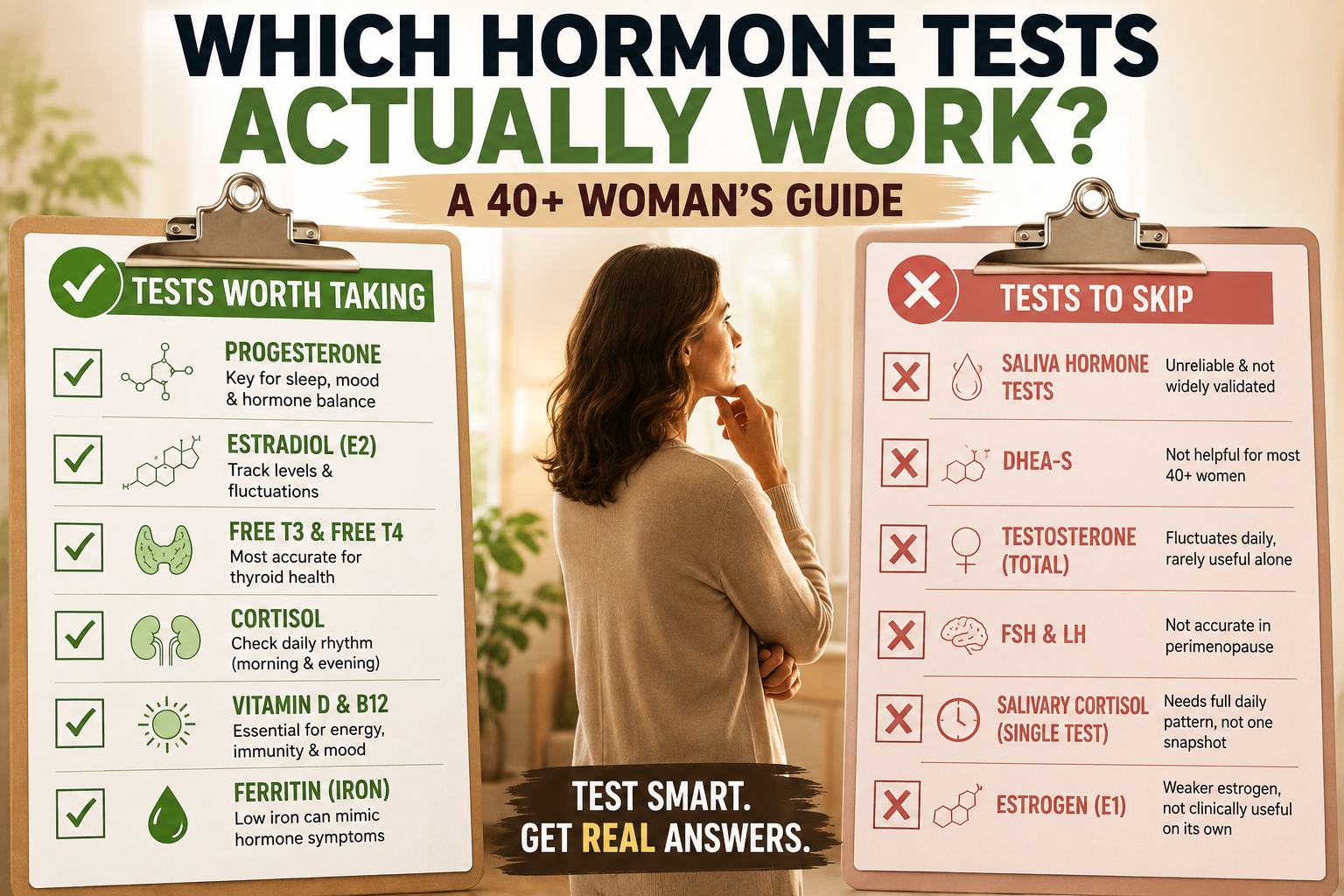
You finally get an appointment with your doctor, you mention that you haven't been sleeping, your moods are all over the place, and your periods have become completely unpredictable — and she orders a single FSH test. The result comes back "normal." And you walk away with zero answers, still feeling like you're losing your mind. Sound familiar? If you've been searching for a perimenopause hormone test and what to ask for, you're not alone — and the frustration you're feeling is completely valid.
This article is going to walk you through exactly which hormone tests matter during perimenopause, what those results actually mean (and what they don't), and how to walk into your next appointment armed with the right questions. Because understanding your hormones isn't just about satisfying curiosity — it's about finally getting the support your body deserves.
Why One Blood Test Won't Give You the Full Picture
Here's the thing about perimenopause that a lot of women don't realize until they're deep in it: your hormones during this phase are not stable. They're fluctuating wildly, sometimes day to day, sometimes hour to hour. A single snapshot blood test can easily catch you on a "good" hormone day and make everything look completely fine — even when you feel anything but.
This is one of the biggest reasons women get dismissed. A doctor checks your FSH once, sees a number that falls within range, and concludes you're not menopausal. But perimenopause is not a single hormonal event. It's a transition that can last anywhere from a few years to over a decade, and during that time, your estrogen and progesterone levels are doing what can only be described as a chaotic dance.
So before you even think about which tests to ask for, understand this: no single hormone test definitively diagnoses perimenopause. The tests are tools to help build a picture — and that picture needs context, including your symptoms and your cycle history.
The Hormone Tests Worth Asking For (And What They Actually Measure)
When you go into your appointment, you don't have to accept whatever gets offered. You can request specific tests. Here's a breakdown of the ones that are genuinely useful during perimenopause.
FSH (Follicle-Stimulating Hormone)
FSH is the most commonly ordered test when perimenopause is suspected, and it's a starting point — but only that. As your ovaries become less responsive, your brain produces more FSH trying to stimulate them. High FSH can suggest your ovarian function is declining, which is consistent with perimenopause. But because hormone levels fluctuate so much, a single reading isn't conclusive. Ask for it to be tested at the right time in your cycle (day 2 or 3 if you're still having regular periods) and consider requesting repeat testing a few months apart if the first result seems confusing.
Estradiol
Estradiol is your main form of estrogen, and tracking it can be incredibly informative. In perimenopause, estradiol levels start to become erratic before they eventually decline. Some days it's higher than it was in your thirties; other days it crashes. Low estradiol can help explain symptoms like vaginal dryness, hot flushes, brain fog, and poor sleep. High or fluctuating estradiol explains symptoms like breast tenderness, heavy periods, and anxiety. It's worth requesting this alongside FSH rather than FSH alone.
Progesterone
Progesterone often gets overlooked, and that's a mistake. In perimenopause, progesterone is usually the first hormone to start declining — often years before estrogen does. Low progesterone leads to irregular cycles, trouble sleeping, anxiety, and heavy or prolonged periods. If you're still cycling, this test should be done around day 21 of your cycle (or 7 days after suspected ovulation) to get a meaningful reading. A result that comes back low or near-zero on day 21 tells you a lot about what might be driving your symptoms.
Testosterone
Yes, women produce testosterone — and yes, it matters. Declining testosterone during perimenopause can contribute to low libido, fatigue, muscle loss, and that flatness that some women describe as losing their spark. It's not always tested routinely, but it's absolutely worth asking for. Free testosterone (not just total) gives you a more useful picture of what's actually available for your body to use.
Thyroid Panel (TSH, Free T3, Free T4)
This one isn't a "perimenopause hormone" test exactly, but it belongs on this list because thyroid dysfunction is incredibly common in women over 40, and its symptoms — fatigue, weight changes, mood shifts, brain fog, sleep problems — overlap almost perfectly with perimenopause. It's easy to chalk up a thyroid problem to menopause and miss it entirely. Ask for a full thyroid panel, not just TSH, because TSH alone can miss early or subclinical issues.
DHEA-S
DHEA-S is an adrenal hormone that acts as a precursor to other hormones including testosterone and estrogen. Levels naturally decline with age, and low DHEA-S can contribute to fatigue, low mood, and poor stress resilience. It's not always the first thing tested, but if you've had the basics checked and still feel like something's off, this is worth adding to the conversation.
What to Actually Say to Your Doctor
One of the most common things we hear from women in their 40s is that they don't know how to advocate for themselves without feeling like they're being difficult. You're not being difficult. You're being your own health advocate, and that's exactly what this situation requires.
Here's a practical approach: go in prepared with your symptom history written down. Not a vague "I feel tired sometimes" — be specific. Note when symptoms started, how they've changed, where you are in your cycle when things get worse, and what impact they're having on your daily life. Doctors respond to specificity.
When it comes to the perimenopause hormone test question of what to ask for, try framing it like this:
- "I'd like to rule out thyroid issues alongside hormonal testing — could we do a full thyroid panel?"
- "Can we test estradiol and progesterone together, not just FSH?"
- "My symptoms are worse in the second half of my cycle — could we time the progesterone test for around day 21?"
- "I'd also like testosterone checked, including free testosterone, because I've noticed changes in energy and libido."
You're not diagnosing yourself. You're helping your doctor help you. That framing tends to work better than arriving with a list that reads like a demand.
Making Sense of Your Results When They Come Back
Getting your results and actually understanding them are two completely different things. Most standard lab reports just tell you whether you're "in range" or "out of range" — but those reference ranges are often enormous, designed for the general population, and not optimized for a woman in perimenopause trying to feel well.
For example, the "normal" range for FSH includes a wide spectrum. A result that's technically normal might still be elevated enough to be clinically meaningful in context. Similarly, estradiol within the normal range can still be low enough to cause symptoms if it's dropped significantly from where you were a few years ago.
Context is everything. Your results need to be interpreted alongside your symptoms, your cycle history, and ideally a series of tests over time — not as a one-time verdict.
If you've had your tests done and you're still piecing things together, the digital resources at orozna.com's perimenopause guides can help you make sense of what you're looking at and give you a clearer framework for the conversations you need to have with your healthcare provider.
When Hormone Testing Has Its Limits — And What Else to Track
There's a version of this journey where you do all the tests, everything comes back within range, and you still feel completely awful. This happens. And it doesn't mean you're imagining it.
Perimenopause is a clinical diagnosis as much as a hormonal one. Many experienced menopause specialists will diagnose perimenopause based on symptoms alone in women over 45, because the hormone fluctuations can be so erratic that testing misses the window of the problem entirely. This is recognised in clinical guidance, and it's worth knowing when you're talking to your doctor.
Alongside hormone testing, tracking your own patterns can be just as valuable. Keeping a daily log of your symptoms, sleep quality, mood, energy, and cycle changes gives you data over time that a single blood test simply can't provide. You start to see patterns — maybe anxiety spikes consistently in the week before your period, or brain fog is worst when your sleep falls apart, or hot flushes arrive in clusters around ovulation. This kind of self-knowledge is genuinely powerful.
There are also other markers worth discussing with your doctor beyond hormones alone: vitamin D, B12, iron, and ferritin can all contribute to perimenopause-like symptoms when low, and they're simple to test.
Hormone Testing in the Context of Treatment Options
Understanding your hormone levels matters most when you're thinking about what to do next. Whether you're considering HRT (hormone replacement therapy), lifestyle changes, or targeted supplements, your baseline hormone picture gives you and your doctor a starting point for informed decisions.
For example, if your progesterone is low but your estrogen is still relatively high, that has implications for which type of HRT might suit you. If your testosterone is low, that's a conversation about a separate treatment. If your thyroid is the main issue, that's a completely different path. The testing doesn't just validate your symptoms — it helps direct the solution.
It's also worth knowing that you don't have to figure all of this out in isolation. Many women find that having access to good educational resources and a community that actually understands this phase makes an enormous difference to how confident they feel navigating it. If you want a clearer roadmap through perimenopause — including how to interpret your health data and what to do with it — the resources at orozna.com are a great place to start.
You Deserve Answers, Not Dismissal
Perimenopause has historically been under-researched, under-discussed, and frankly, underprioritised in women's healthcare. Too many women have spent years being told their symptoms are anxiety, or stress, or just "getting older" — when actually, their hormones were doing something real and treatable.
Knowing which perimenopause hormone tests to ask for, and understanding what those results actually mean, is one of the most practical ways to change that experience for yourself. You don't need to become an expert overnight, but you do need enough knowledge to ask better questions and push for more complete answers.
Your symptoms are data. Your body is telling you something. And a good hormone panel, interpreted properly with full context, is one of the most useful tools you have for figuring out what that something is. Take the symptom log to your next appointment, ask for the full panel, and give yourself permission to keep pushing until the answers make sense — and if you need support building that knowledge foundation, exploring the digital resources at orozna.com is a genuinely useful next step.